
Peter Lik Photography — Prints, Prices & Where to Buy
If you've walked past a Peter Lik gallery — in Las Vegas, New York, or Hawaii — you already know the feeling. Those floor-to-ceiling landscapes seem to glow from within, filling the room with a presence that's hard to explain until you've stood in front of one.
This guide covers everything worth knowing about Peter Lik: who he is, how his prints are made, what they cost, and what your options are if you want that same museum-quality look in your home.
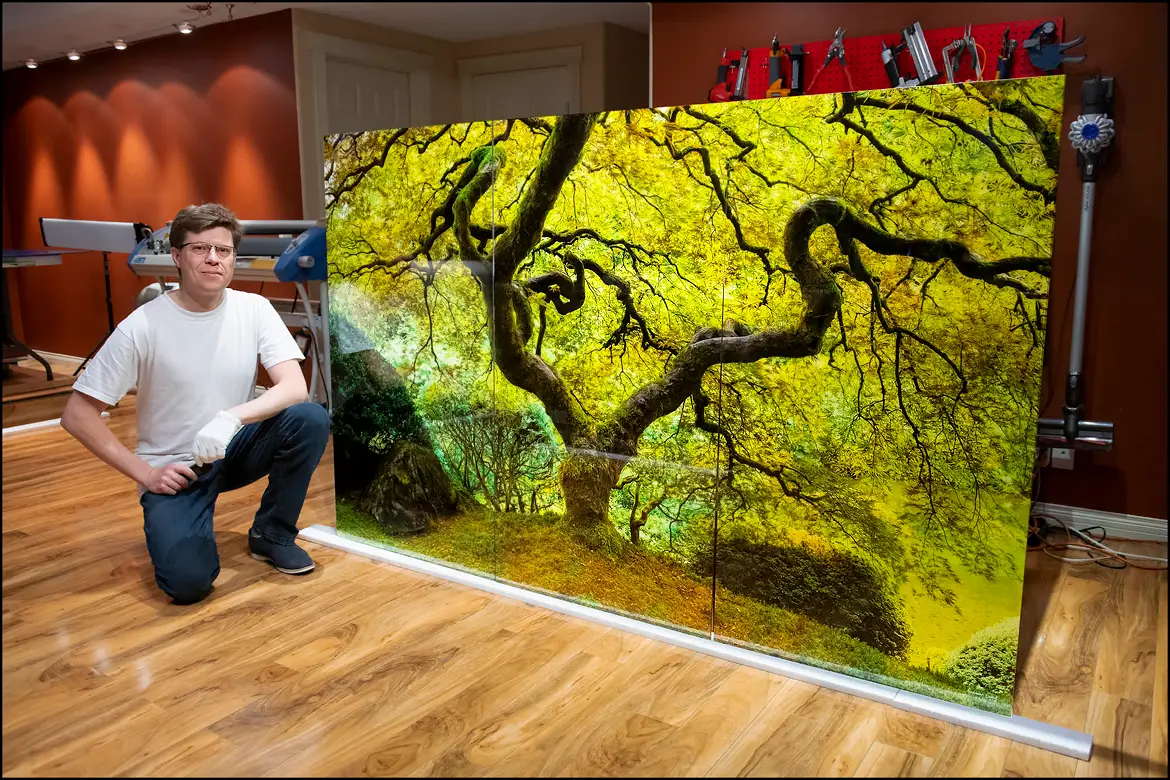
Jump to a section:
- Who is Peter Lik?
- What makes Peter Lik prints look that way?
- Famous work by Peter Lik
- What camera does Peter Lik use?
- Peter Lik gallery prices
- Where are Peter Lik’s galleries?
- What paper does Peter Lik print on?
- What is the Peter Lik style?
- How to print like Peter Lik
- Why are Peter Lik photos so expensive?
- What is acrylic face-mount?
- Acrylic printing vs. acrylic face mounting
- Where to buy Peter Lik prints
- Is there a more affordable alternative?
- Frequently asked questions
Who is Peter Lik?
Peter Lik is an Australian landscape photographer born in Melbourne in 1959. He first visited the United States in 1984, travelling through Alaska, and was so struck by the American landscape that he returned repeatedly over the following years — eventually building a life and a business around photographing it.
He opened his first gallery in Port Douglas, Australia, in 1990. His US expansion began in the early 2000s with a flagship location in Las Vegas, where the gallery format — dramatic lighting, enormous prints, velvet rope atmosphere — proved to be a perfect match for the city.
Today the Peter Lik gallery network spans more than 15 locations across the United States, including Las Vegas (multiple galleries), New York, Chicago, Hawaii, and several resort destinations. Each gallery operates on a similar model: trained consultants walk visitors through the collection, and prints are available for purchase at fixed gallery prices.
Lik has received significant media attention — and considerable controversy — for record-breaking print sale claims. His photograph Phantom was reportedly sold for $6.5 million USD in 2014, a figure that would make it the most expensive photograph ever sold privately. Art world observers have questioned the sale, but the claim remains part of his brand narrative.
What makes Peter Lik prints look that way?
The signature Peter Lik aesthetic — that luminous, almost backlit glow — is not a post-processing trick. It comes from a specific combination of print materials and presentation technique.
Silver crystal metallic paper
His prints have historically been produced on silver crystal metallic photographic paper — a chemically processed substrate with metallic particles embedded in the emulsion layer. When light hits the surface, those particles reflect it from within, creating a depth and luminosity that standard photo paper simply cannot produce.
Acrylic face-mounting
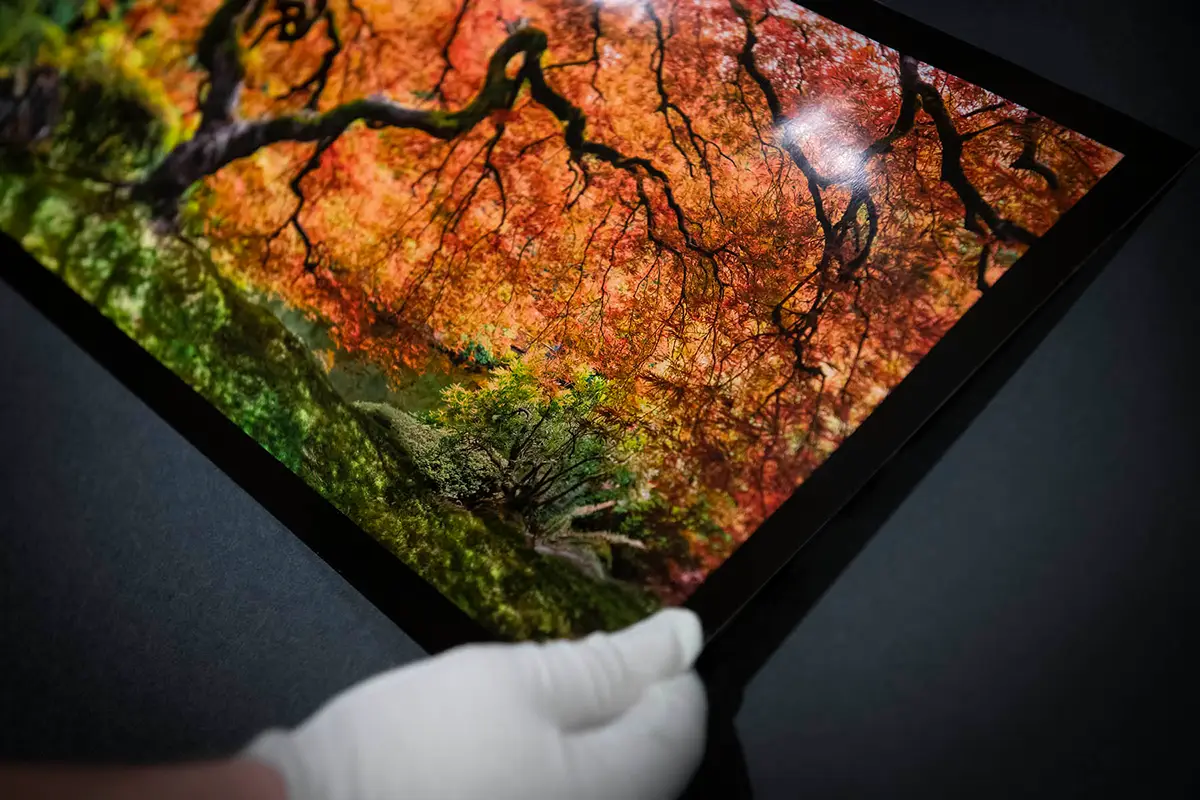
The print is then bonded face-first to a sheet of museum-grade optical acrylic — typically 6mm or thicker. The acrylic acts as a lens, refracting ambient light across the surface and amplifying the metallic paper's natural luminosity. The result changes with the light in the room: different times of day produce subtly different effects.
Floating mount hardware
The finished acrylic panel is mounted using concealed standoff hardware, creating a gap between the print and the wall. This floating presentation enhances the three-dimensional quality and is the finishing touch that makes these prints feel fundamentally different from framed photography.
The 2025 process change
In January 2025, Peter Lik announced that his studio has transitioned from silver halide photographic paper to Hahnemühle Fine Art Paper produced with Epson SureColor inkjet technology. This marks a shift from traditional chemical processing to pigment ink printing — a more environmentally sustainable approach. The acrylic face-mounting presentation remains unchanged. The visual difference to the naked eye is minimal, as the acrylic is primarily responsible for the signature glow.
Famous Work by Peter Lik
There is a number of landmark photographs of Peter Lik that often decorate the main feature walls at the storefront of his galleries.
1. Phantom - A photo made inside of Upper Antelope Canyon in Page, Arizona. The photo was allegedly sold for record breaking $6.5 million to an undisclosed buyer.
2. Tree Of Life - A photograph of a Japanese Maple tree located in the Japanese Garden of Portland, Oregon.
3. Sacred Sunrise - A photograph of the sunrise bursting its rays under the Mesa Arch in Canyonlands National Park.
4. Endless Summer - A seascape featuring the Scripps Pier in La Jolla, California.
5. Spirit Of the Universe - A lavender field under the Milky Way spanning above the sun-lit clouds shortly after the sunset.
6. Ghost - Another photograph of Antelope Canyon with a similar subject as the Phantom.
7. One - A photograph of autumn trees reflecting in the water. The print was reportedly sold for $1 million.
What Camera Does Peter Lik Use?
Lik is best known for his panoramic photographs captured with a Linhof 617 Technorama and using Fuji film. He is featured in several photographs with this monster in his arms. Peter is more of an athletic type but I doubt he enjoys carrying this monster around on long hikes.
Linhof 617 Technorama

Linhof 617 is a panoramic 6 x 17cm frame size camera. It is now available at around $7k new or around $5 to $6k used and uses 120 and 220 roll films. Although there may be a rare situation where this camera is preferable to the latest full-frame Nikon digital panned three times for panoramic capture but I wouldn't bet at those odds.
Phase One
Another camera Peter Lik used is a Phase One. This brand is known for its modular XF medium format design.

The idea behind this design is that you don't have to replace the whole camera when technology advancement produces better image acquisition electronics. You just swap the backing like you would re-load the film on the analog cameras and you immediately will obtain upgraded capability. This beauty is not for everyone though. The current listed price of the latest Phase One 100MP camera with an 80 mm lens is 48,990 USD.
FujiFilm GFX100
The next one on the list is FujiFilm GFX100. This baby is a much more affordable alternative to 100MP Phase One. With the price tag of approximately $10k for a body, it comes closer to the professional full-frame systems but not quite there yet. Prepare to shell out another $3k for a lens and you'll be ready to hit the road.

Nikon D850
And lastly, Peter Lik also used Nikon D850 and I'm sure his backpack was much lighter when he did. The 850 is a magnificent 46MP full-frame camera that is capable to produce amazing images with a very wide dynamic range. I personally forgot when was last time when I had to do bracketing using this camera. Even on the most contrasting scenes, it masters to capture the full range.

Peter Lik gallery prices
Peter Lik prints are sold exclusively through his gallery network and are not available through third-party retailers or auction houses (aside from private resale).
Pricing is tiered by edition size and print dimensions:
| Edition type | Edition size | Starting price |
|---|---|---|
| Standard edition | Up to 950 prints | USD $3,500 |
| Limited edition | Up to 450 prints | USD $6,500+ |
| Exclusive edition | Up to 95 prints | USD $15,000+ |
| Artist proof | Varies | USD $20,000+ |
These are approximate starting prices for smaller sizes. Large format prints — 60" and above — in limited editions can reach USD $50,000–$150,000 or more. Gallery consultants do not typically publish prices publicly; the figures above reflect reported sales and collector community research.
What drives the price:
- Edition size: smaller editions command higher prices
- Print dimensions: larger sizes cost significantly more
- Subject matter: Antelope Canyon and signature series prints carry a premium
- Frame and finish: TruLife acrylic, custom framing, and float mounts add cost
Is Peter Lik photography a good investment?
This is a contested question. Unlike blue-chip fine art, photography prints — even limited editions — rarely appreciate significantly at resale. Peter Lik prints do appear occasionally at auction, typically at prices below original gallery retail. Collectors who purchase primarily for aesthetic enjoyment rather than investment return tend to be more satisfied with the transaction.
Looking for the same quality at a fraction of the price?
Independent artists using identical print processes offer museum-quality acrylic-mounted prints without the Las Vegas gallery overhead. See how Alex Gubski compares.
Where Are Peter Lik's Galleries?
Peter Lik's galleries are strategically placed in major tourist destinations—from Las Vegas to New York to Miami. In fact, Las Vegas alone hosts four Lik Fine Art galleries, attracting thousands of art lovers daily.
- New York. Lik Fine Art - The Shops at Columbus Circle
- Aspen, Colorado. Lik Fine Art Aspen at 406 E Hopkins Ave
- Caesars, Las Vegas, Nevada. The Forum Shops at Caesars, Third Floor, 3500 South Las Vegas Boulevard, Suite T-10. Phone: +1 702-836-3310
- Forum, Las Vegas, Nevada. Suite N-09, Las Vegas, Nevada 89109. Phone: +1-702-369-8239
- Key West, Florida. 400 A Duval St, Key West, FL 33040. Phone: +1-305-292-2550
- Lahaina, Maui. Tragically destroyed in the Lahaina fire in Summer 2023.
- La Jolla, California. 1205 Prospect Street, La Jolla, California 92037. Phone: +1-858-200-0990
- Peter Lik NYC — The Shops at Columbus Circle, Floor 1, 10 Columbus Circle, Suite 118, New York, New York 10019. Phone: (212) 941-6391
- Mandalay Bay, Las Vegas, Nevada. 3930 Las Vegas Boulevard, Suite 131, Las Vegas, Nevada 89118. Phone: +1-702-309-9888
- Miami, Florida. 655 Lincoln Road, Miami Beach, Florida 33139. Phone: +1-786-235-9570
- The Venetian, Las Vegas, Nevada. 3377 Las Vegas Blvd S, Suite 2071, Las Vegas, NV 89109. Phone: +1 702-309-8777
- Park City, Utah. 592 Main Street, Park City, Utah 84060. Phone: (435) 599-7119
Given the sheer number of tourists who pass through these venues, it's no wonder Peter Lik has become the face of acrylic photography. But he's not the only artist creating this style of work.
Most of Lik's galleries are outfitted with light-controlled showrooms to showcase the prints to potential customers. Peter Lik's finishing method of choice is the acrylic face-mount technique — one of the most expensive methods of photo finish and probably the best for conveying the essence of photography.
What Paper Does Peter Lik Print On? (Updated 2025)
Peter Lik built his reputation on FujiFlex Crystal Archive silver halide paper — a chemically processed photographic paper known for its exceptional tonal range, fine grain, and archival stability. For many years this was the gold standard for large-format fine art photography.
In January 2025, Lik announced a significant shift: his studio has moved entirely to Hahnemühle Fine Art Paper produced with Epson SureColor inkjet technology. This marks a transition from traditional silver halide chemistry to modern pigment ink printing — a more sustainable, environmentally conscious process.
It's worth noting that pigment ink printing technology has advanced to the point where the visual difference is virtually indistinguishable to the naked eye, particularly when combined with acrylic face-mounting. The acrylic itself — not the paper — is primarily responsible for the luminous, depth-filled appearance that makes these prints so striking.
I continue to use the wide range of silver crystal metallic papers, including Hahnemühle, Epson, Fuji & Kodak with acrylic face-mounting — the same metallic substrate that made the original Peter Lik prints so distinctive. The metallic particles embedded in the paper reflect ambient light from within, creating the glowing, almost backlit quality that stops people in their tracks. For a deeper technical comparison of silver halide vs. modern metallic inkjet media, see my FujiFlex and Fuji Crystal article.
What is the Peter Lik Style?
Lik's signature style that fascinates so many guests visiting his galleries is a spectacular presentation technique built on three elements:
Firstly — all images are printed in large format for maximum visual impact.
Secondly — all images are face-mounted on acrylic. This is the finishing method of choice for Peter Lik.
Thirdly — if framed, the vast majority are set in wide linen-wrapped liners and expensive frames, in contrast to traditional photo print presentation with cardboard matting and plain minimalistic frames.
And finally, if it's a color print, it will sport a particularly high level of color saturation. If you're interested in learning about prices on some of Peter Lik's images and their availability on the secondary market, please read my post on Lik's secondary market.
How to print like Peter Lik?
If you've visited a Lik gallery, you've probably experienced that awe. The photographs don't just hang—they command the space. They shine. They seem to glow from within.
I was making acrylic mounted prints over the past decade and learned a few things about the process, display properties, longevity, and many other aspects of this type of art. In my opinion acrylic face-mount is the ultimate finishing style for fine art photography.
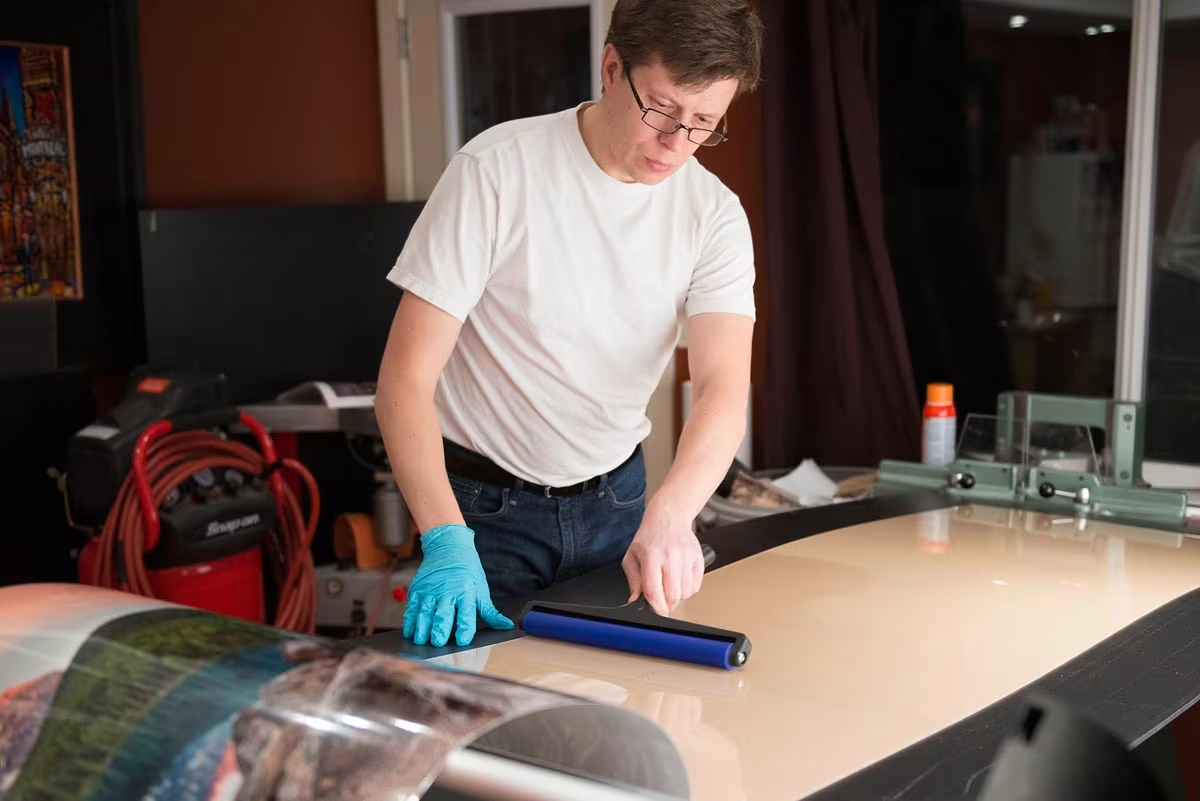
For a while, I didn't have a chance to properly inspect Peter Lik's print in person outside of what I saw at his galleries. Until a client of mine asked me to frame a print he bought on the second-hand market. He sent me the print and I had an opportunity to inspect it up close. The print I had in my hands had what looked like a metallic glossy photopaper encapsulated between 3 mm thick front layer and a 1 mm thick backing. I was pleased to see that the general look and feel of the print were very similar to what I was producing. The only exception is that I only sometimes use acrylic on both sides of the print while Peter Lik seems to use it all the time. I frequently use composite board like Dibond™ for exceptional flatness and weight advantages.
If you like to learn more about the process please read my blog post on How to Print like Peter Lik.
Why Are Peter Lik Photos So Expensive?
Peter Lik's photos come with a big price tag—and it's not just about the art itself. His galleries are set up in some of the most popular and luxurious vacation spots, where rent is sky-high. Then there's the team of well-trained sales reps whose job is to make every buyer feel like they're getting a truly exclusive experience. On top of that, producing each print involves high-end materials like acrylic face mounting and a top-notch production facility that isn't cheap to run. When you mix in the limited edition nature of the prints, it's easy to see how all these pieces add up to such premium pricing.
What is Acrylic Face-mount?
Face-mount is a production and presentation method for graphic art, mostly photography. The photographic print is permanently sandwiched with the print face adhering to the acrylic panel, and the back of the print is backed to either one of a number of rigid composites, such as Sintra, FoamCore, Dibond, or another sheet of acrylic. The result: extreme depth, detail, and a vibrant “backlit” appearance when lit from the front. The optical clarity of the acrylic enhances contrast and saturation, making the print come alive.
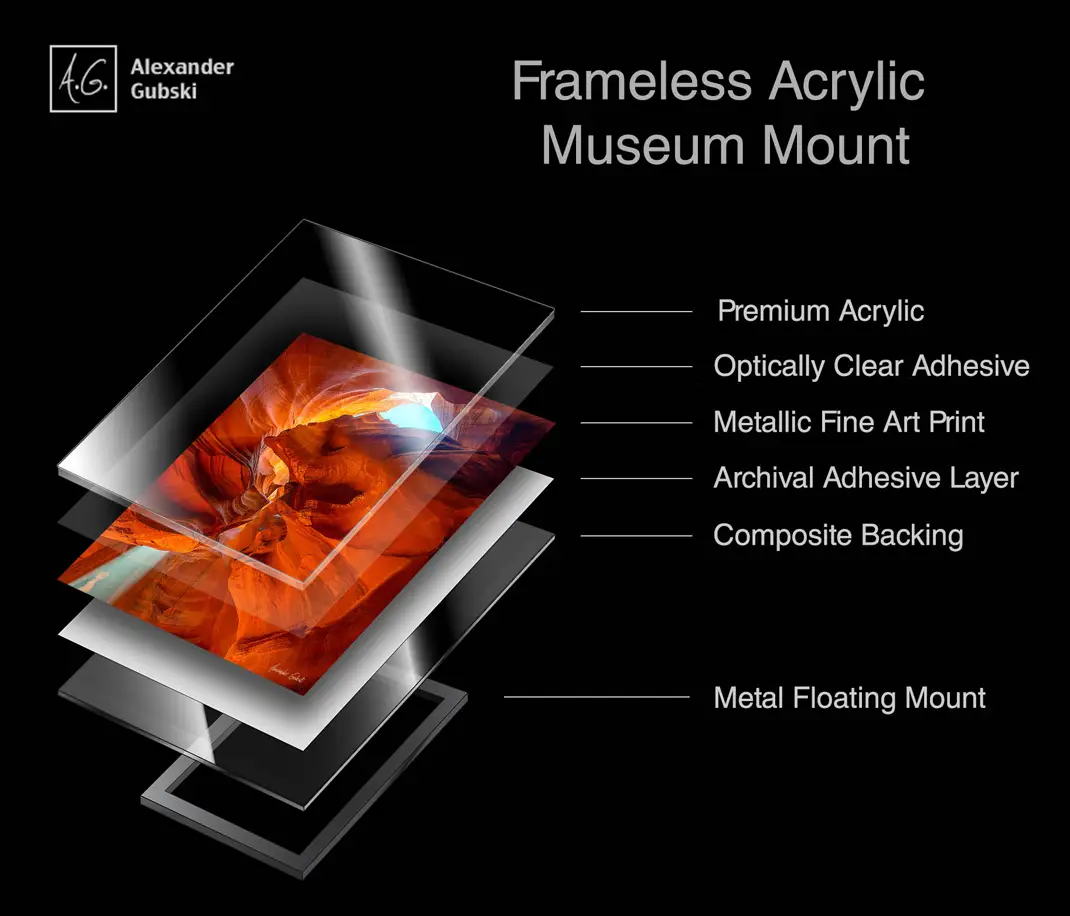
For me, the selection of the backing usually depends on the size of the print. For larger pieces, I almost exclusively use composite panels for their rigid properties which allow me to avoid deformations during mounting and float-mount application. For smaller pieces, I often use acrylic which has an attractive translucent edge.
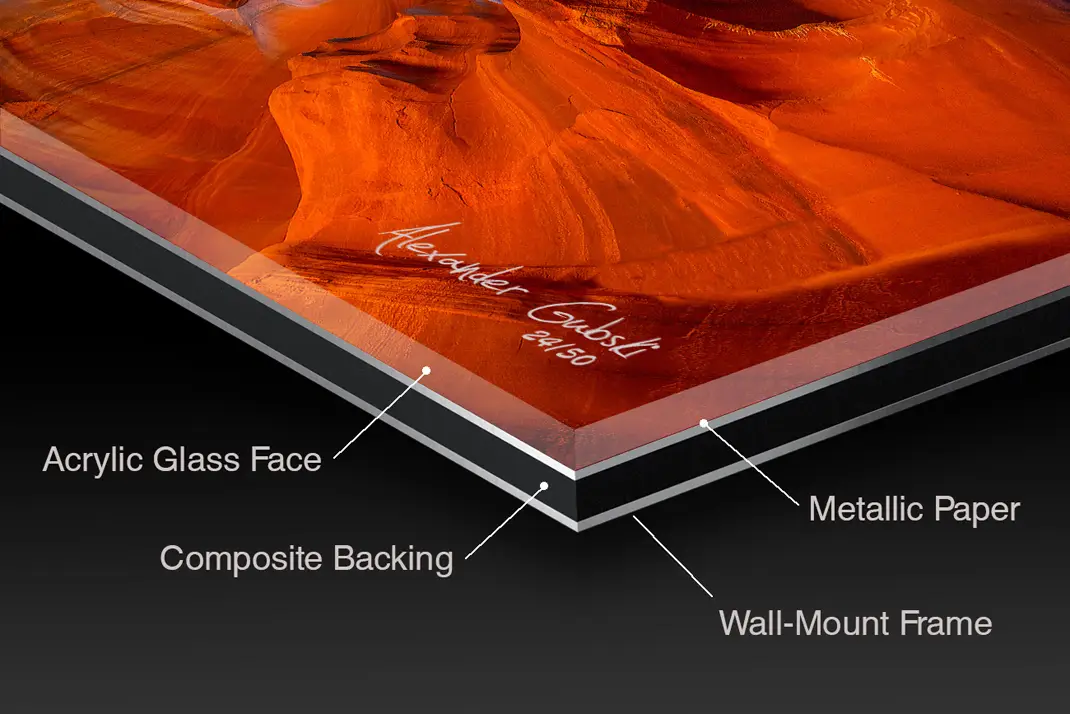
The resulting package is super flat, especially comparing to free-floating prints mounted under glass, which can deform and warp with humidity. Clarity and vibrance are key characteristics that multiply the traits of a photographic print making it a true piece of art.
Own the Same Look — Made by the Artist
The acrylic face-mount process Peter Lik built his reputation on is the same process I use for every print. The difference is that mine are produced in editions of 25 to 100 — not 950 — and made by my hands from start to finish.
If you're looking for a statement piece for your home without gallery pricing, I'd love to show you what's possible.
Acrylic Printing vs. Acrylic Face Mounting
Some shops offer acrylic prints that are not the same as acrylic face-mounted pieces. The acrylic prints are made by printing directly on an acrylic panel using specialized solvent-based inks. While at first glance such prints may look similar and even offer a cost incentive, you will quickly realize their disadvantages. To see the difference, you need to see them displayed next to a metallic media face-mounted print. The metallic papers carry tiny metal particles infused into the surface of the paper, increasing the reflectivity of the images and creating a so-called backlit effect.
Where to buy Peter Lik prints
Peter Lik galleries (primary market)
The only authorised source for new Peter Lik prints. Locations include Las Vegas (Forum Shops, Grand Canal Shoppes, and others), New York, Aspen, La Jolla, and several Florida and Hawaii locations. A full list is available at lik.com.
Private resale (secondary market)
Peter Lik prints occasionally appear on platforms like 1stDibs, Invaluable, and specialist fine art resellers. Prices vary widely. Authentication documentation (certificate of authenticity, edition number, artist signature) should always be verified before purchase. For more on secondary market pricing, see my Peter Lik for sale guide.
Auction houses
Lik prints appear infrequently at major auction houses. Results have generally been below gallery retail, which is typical for photographic prints in the secondary market.
Is there a more affordable alternative?
The look Peter Lik built his reputation on — silver crystal metallic paper, acrylic face-mounting, floating mount presentation — is not proprietary technology. It is a print production process available to any fine art photographer willing to invest in the materials and craft.
I'm Alex Gubski, a Calgary-based landscape photographer. I produce every print myself — from the original capture through printing, mounting, and packing for shipment. My editions range from 25 to 100 copies, significantly more exclusive than Lik's standard editions of up to 950. Acrylic and metal finishes start from USD $1,500; see the full starting-price chart. Prints ship free to USA, Canada, and Europe.
The difference is not the quality of the print — it's the absence of a gallery network with 15 locations to support. That overhead is what you're paying for when you buy from a Las Vegas gallery. Buying directly from the artist removes it entirely.
See the full comparison — Alex Gubski vs Peter Lik →
Browse the Collection → Request a Free Room Mockup →
Frequently asked questions
Is Peter Lik the most expensive photographer in the world?
He has claimed the record for the most expensive photograph ever sold privately — Phantom at $6.5 million in 2014. However, this was a private sale and has not been independently verified. In the public auction market, other photographers hold higher verified records. For a good overview of most expensive photos ever sold please read my blog post on The Most Expensive Photograph Ever Sold.
Are Peter Lik prints worth the money?
For collectors who value the aesthetic experience and gallery presentation, many find them worthwhile. As financial investments, photography prints rarely appreciate significantly at resale. If the primary goal is owning a stunning acrylic-mounted landscape print for your home, there are independent artists producing equivalent quality at a fraction of the gallery price.
Can you buy Peter Lik prints online?
Yes — Peter Lik operates a full e-commerce storefront at
lik.com where you can
purchase Limited Editions, Open Editions, and Best Sellers directly. Prints are
also available through his physical gallery network across the US, and on the
secondary market via platforms like 1stDibs and auction houses.
What is the difference between Peter Lik's TruLife and standard acrylic?
TruLife is a premium acrylic product by Tru Vue that offers enhanced anti-reflective properties and superior UV protection compared to standard optical acrylic. It is used for his highest-tier editions and is available as an upgrade option at additional cost.
How long do Peter Lik prints last?
Acrylic face-mounted photographic prints, when properly cared for and kept out of direct sunlight, are rated for 75–100+ years of display life. The acrylic itself provides significant UV protection. Silver halide prints (his historical process) and high-quality pigment ink prints (his current process) both meet museum archival standards.
Non-Affiliation Disclaimer
Alexander Gubski Photography is an independent business. Alexander Gubski is not affiliated, associated, authorized, endorsed by, or in any way officially connected with Peter Lik or the other owners of respective brands mentioned on this website. As well as with any of their subsidiaries or their affiliates. All brand names, as well as any related names, marks, emblems, and images, are registered trademarks of their respective owners. These trademark holders do not sponsor or endorse Alex Gubski Photography or any of its products or comments.